
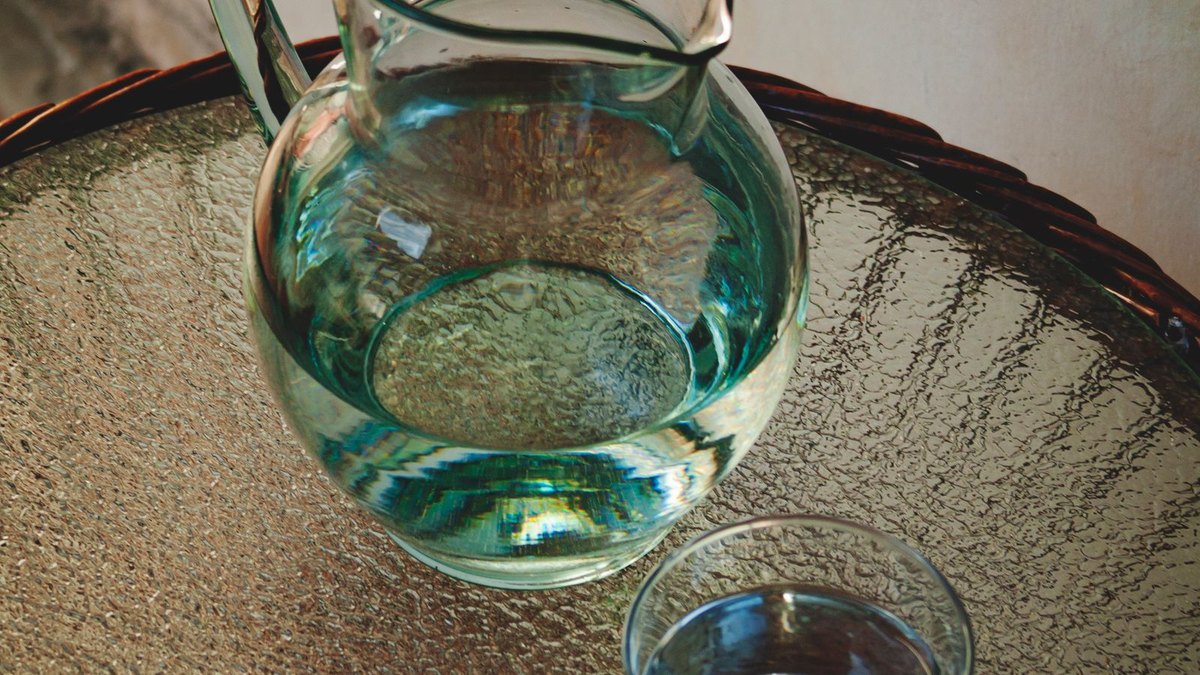
A jug of water on the table — a hob habit, not a litre target
While the onion colours I pour from the jug. It lives on the table, not in a cupboard. If I cannot see it, supper arrives with only tea left.
Why it sits on the table
I do not cook for ten minutes. Borscht, a pie, kotlety — an hour or two at the hob. Hands in flour or mince, back to the tap. Water in the fridge does not exist for me: by the time the potatoes float I will not have gone there. The jug stands on the table by the board. Eye falls — hand follows. Not a magazine ritual. So I am not dry-mouthed at supper, grabbing the compote first while the soup is still hot. A British kitchen table is narrow. The jug still fits if I do not lay out every chopped pile at once. I put it where the salt and the stirring spoon live. Guests — I do not hide it. Whoever wants some can pour. A glass in the cupboard cannot be seen, so it is not there. What sits in sight is what gets used.
Which jug, and how I fill it
Glass, about a litre and a half, with a lip. Not a plastic filter jug that lives on the fridge shelf and is remembered on Wednesday. Morning: I fill it from the tap. Tap water in Britain is fine. I will not boil it for drinking — the kettle is for tea. I do not click a lid as I would on jam. Evening: leftover goes, I wash the jug, stand it to dry by the board. I do not finish yesterday's water 'to save it'. Leave it unwashed and it smells of yesterday's onion. Sometimes a slice of lemon, if the lemon is already cut for fish or tea. Not for a photograph. Three hours at the hob are easier when the water is not utterly blank. Mint only if it already stands with the herbs. I do not go into the garden for a sprig just to flavour a glass.
When I drink — and when I keep my hands out
Onion colouring — a sip. Dough rising — a sip. Soup reducing — another. No timer. No app. If my hands are in mince I pour a glass first: dirty fingers stay out of the jug. When the pie is already in at one hundred and eighty, those ten quiet minutes are when I can sit and drink properly, not on the run at the pan. Children ask for juice — juice belongs at the table, not instead of water while I fry. Tea is for supper. Water is while I cook. In winter the jug is room temperature. Ice-cold from the fridge at the hob makes you flinch, and you still have to stir. In summer, a little cooler.
What sits beside it
- Filled fresh in the morning — not yesterday's pour
- If hands are busy — a glass already stands beside me
- By evening pour the rest away and wash the jug
- Do not drink from the jug's mouth over the pot
- Guests pour for themselves; I do not hide the jug
What I do not do
I do not measure two litres. I do not drink 'as in a short film'. I do not thin the borscht in the bowl because 'you need fluid' — borscht is already soup. If I want compote I make compote. This is a kitchen, not a table of numbers. And I do not keep the same filling for a week. Washed — filled again. Same as oil in the pan: not until it smells of Tuesday.
From this same kitchen
Dill and parsley also stand in a glass of water here — there is a note on how to store so you are not binning it. The drinking jug and the herb glass are different things. Water in this kitchen is not hidden in a cupboard. The rest of the kitchen notes — salt, oil, sugar, calories — sit together, not a diet club. Photo: Arturo Añez, Pexels.
These are starting figures for adults, not a medical prescription.